I get it. You don’t like to scoop the litter box. So the promise of a robotic litter box sounds like a dream.
But you should know that I am a holistic cat behavior trainer, and I never, ever recommend automatic self-cleaning litter boxes to my cat parent clients – regardless of how small their place is or how desperate they are to shortcut the five seconds they spend scooping the litter box.
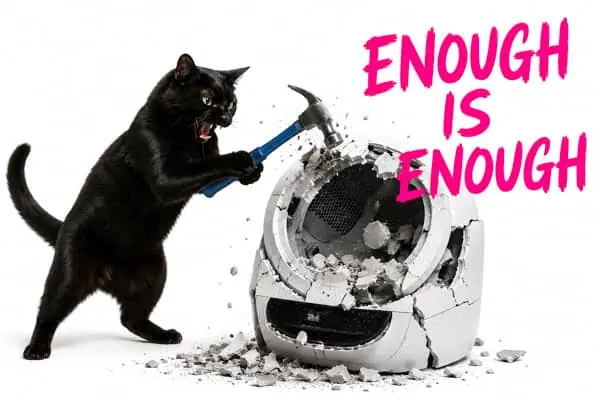
Self-cleaning litter boxes are an absolute nightmare for cats.
They ruin the litter box experience all day – every day, create accumulated stress overtime, and can easily lead to litter box avoidance down the line once your cat becomes so fed up with the daily struggle associated with using them.
This post is my loud scream on behalf of all the cats who struggle with the daily stress of using self-cleaning litter boxes.
Here’s what’s wrong with self-cleaning litter boxes, why cats hate them, and why you should avoid using them at all costs.
Self-Cleaning Litter Boxes Are a Cramped “Porta-Potty”
Before we get into the nitty-gritty of what’s wrong with self-cleaning litter boxes from your cat’s point of view, I want you to visualize this.
Self-cleaning litter boxes are very similar to a porta-potty – those tiny portable bathrooms you find at construction sites and remote hiking locations.
You using a porta-potty and your cat using a self-cleaning litter box are the exact same experience.
So I want you to go use a porta-potty somewhere and pay attention to how it makes you feel. Then ask yourself if that’s something you would choose to use all day, every day for the rest of your life.
If the answer is, “Hell… no,” then make it up to your cat and buy them a decent litter box they’ll actually enjoy using.
The Size Illusion: The Usable Interior Space Is Way Too Small
There is a massive gap between the external, clunky dimensions of a self-cleaning litter box and its actual usable interior space.
The “largest” self-cleaning litter boxes on the market often have an exterior diameter of around 20 inches long. The usable interior space is, at best, about two-thirds of that – roughly 13 inches long.
For a cat to use a litter box comfortably, they need approximately 24-28 inches of interior length.
That’s about double the usable space offered by most self-cleaning litter boxes.
That’s the equivalent of forcing a human to use a bathroom where they can’t fully stand up or turn around – a true porta-potty for cats.
Sensory Deprivation: Navigating in the Dark
Cats have a very particular digging, burying, and self-cleaning sequence inside the litter box.
They need to go in, turn around, dig, turn around again, do their business, turn around, cover it, and then clean themselves – all while staying inside the litter box.
By design, self-cleaning litter boxes are enclosed globes. Once your cat is inside, they’re in a sensory vacuum.
They struggle to perform their natural digging and burying sequence because they can’t properly see where they’ve already stepped. That’s on top of the small size and the awkward shape of automatic litter boxes, which leads to dirty feet and unnecessary stress.
The Prison Cell: No Escape for the Fearful
Self-cleaning litter boxes are essentially one-way tunnels with almost no visibility of the outside world.
That alone can add enormous stress for fearful or anxious cats while they’re trying to do one of their most vulnerable daily activities.
It’s much harder for them to escape quickly if something in their environment startles them.
Then there’s the ambush risk in multi-cat households. A cat inside the litter box cannot see if another cat is waiting outside to ambush them at the exit or block them from entering in the first place.
The Ventilation Void: The Price Your Cat Pays for Your Convenience
Self-cleaning litter boxes are designed to trap odors inside so you don’t smell them.
Meanwhile, your poor cat – the one with the incredibly sophisticated sense of smell and the one who actually has to climb inside – is breathing a concentrated mix of litter dust, urine, and feces.
It’s a stagnant, high-concentration, smelly environment that can easily irritate your cat’s sensitive respiratory system.
The Scary Noise: The “Haunted House” Effect
The mechanical whirring, grinding, and shifting of litter often happens just minutes after your cat leaves.
If the litter box moves or makes frightening noises while your cat is still nearby, it can create a permanent fear association with the litter box itself.
The “Mechanical Failure” Nightmare
Because these machines promise a “set it and forget it” lifestyle, many cat parents stop checking the litter box altogether.
Sensors can jam, motors can burn out, or a simple Wi-Fi glitch can stop a cleaning cycle halfway through.
When that happens, the waste isn’t just sitting there – it’s often trapped in a half-rotated position that makes the usable surface area even smaller.
Now your cat is expected to use an already stressful litter box that’s also filthy – a hard no for most cats.
I’ve actually seen self-cleaning litter boxes stop working during coaching sessions multiple times, and my clients hadn’t even noticed. They were so dirty, and the poor cats still had to use them.
This is more common than you might think.
Holistic Behavioral Takeaways
A self-cleaning litter box turns your cat’s most vulnerable daily habit into an unpredictable hazard, a daily struggle, and a constant source of stress that builds over time until they reach their breaking point.
Then, all of a sudden, you’re dealing with a litter box problem that seems to come out of nowhere!
I hope I’ve made my point loud and clear – and that you now dislike self-cleaning litter boxes as much as I do… and as much as your cat does.
Our cats deserve so much better than this.
If you’re ready to make the switch, check out my top recommended litter boxes for adult cats to see what an appropriate litter box actually looks like. And the best litter box setup for cats.
If your cat is currently struggling with the litter box, here are the most common root causes of litter box avoidance.
If you need 1:1 help, check out my 1:1 Online Cat Behavior Breakthrough Session, where we address and resolve the root causes of your cat’s litter box struggles.
I’m a holistic cat trainer based in Vancouver, supporting conscious, loving cat parents locally and online across Canada and the US through my signature holistic cat training programs and cat introduction programs.
Regulation Starts in The Bowl

Get your FREE cat food ingredient decoder to learn how to read labels like a pro, and know which brands to buy and avoid.
Related Posts:
- My Top Pick Cat-Approved Litter boxes For Adult Cats
- The Ultimate Cat-Approved Litter box Setup
- Your Cat’s Litter box Problem Is a Desperate Cry for Help – Don’t Ignore It
- Litter box Rage Is Real: 8 Fatal Cat Litter box Mistakes That push Your Cats To The Edge
- Why Your Senior Cat Is Peeing Outside the Litter Box (And What to Do About It)