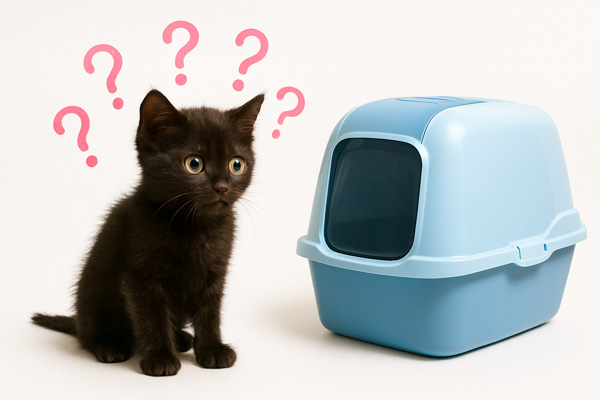
Why isn’t my kitten using the litter box?
Whether your kitten uses the litter box sometimes or not at all, this post is for you. I’m about to walk you through the most common litter box mistakes kitten parents make, and set your expectations straight so you stop panicking and actually understand what your kitten needs from you.
Kittens are babies. They’re learning a brand-new skill.
If you get the litter box setup wrong, the training wrong, or the timing wrong, you’re guaranteed to run into problems.
Let’s fix that.
Mistake #1: Using the Wrong Litter box for Your Kitten
Kittens MUST be trained in kitten-only litter boxes.
This is the biggest, most common mistake across the board.
Your kitten is not physically or emotionally ready to navigate an adult cat litter box.
High walls, covered boxes, huge spaces, dark corners – all of that feels intimidating or physically hard to climb into.
Buying an adult litter box early doesn’t “save money.” It just makes training harder, slower, and more confusing for your kitten.
A proper kitten litter box is: open, shallow, low entry, and small enough that your kitten feels safe
This alone prevents half the issues people struggle with.
Mistake #2: Getting Only One Kitten Litter box
One litter box is for fully trained adult cats, not young kittens who are still learning. Even if you only have ONE kitten (which I hope isn’t the case, because kittens should always be adopted in pairs), you still need 3-4 litter boxes, for an average size room, placed throughout your kitten’s safe room.
Your kitten needs:
- Constant visual reminders
- Multiple easy-access options
- The chance to explore, dig, and practice
Even in a tiny room, they need one in every corner.
Kittens can’t “hold it.” They go when the urge hits.
Mistake #3: Placing the Litter boxes in Challenging Locations
Under furniture? Inside a closet? Inside a litterbox enclosure? Behind obstacles? Like seriously?!
Don’t expect your kitten to navigate an obstacle course, squeeze into a dark space, or even remember where the litter box is when their tiny body suddenly says “NOW.”
The litter boxes need to be:
- In plain sight
- In each obvious corner, or by open walls, or even in the middle of the room
- EASY to reach
- EASY to spot
- Not blocked or hidden
Yes, even if it ruins your aesthetic. This is temporary. Training comes first.
Mistake #4: Using a Highly Scented Litter
Cats rely on scent to feel safe – and kittens rely on scent even more because their nervous system is still maturing. They navigate the world through their noses first. So their noses are extremely sensitive.
Highly scented litter:
- Overwhelms them
- Irritates their noses
- Masks their own scent markers, which confuses them, and even drives them away from the litter box
Choose natural, unscented, or VERY lightly scented litter only
Your kitten will thank you.
Mistake #5: Using Clumping Litter (This is A Health Hazard)
I HAVE to mention this one because so many kitten parents still do it, thinking it makes scooping easier.
Most kittens taste or ingest litter at some point – this is normal exploration. If they swallow clumping litter, it clumps inside their digestive system. This is not a minor issue. It is a blockage risk.
Young kittens must ONLY use non-clumping litter until:
- They’re fully litter box trained
- They’re old enough
- They understand that litter is NOT food
Your convenience is not worth the medical risk.
Mistake #6: Cleaning the Litter box too often OR too little
This goes both ways:
- Clean too often? If you remove every single pee or poop instantly, your kitten loses the scent reminder that helps them identify: “Oh, this is where bathroom stuff goes.”
- Clean too rarely? If your litter box smells like a toxic gas leak, your kitten will avoid it.
You have 3-4 training litter boxes, so scooping 1-2 times per day is perfect not obsessively not rarely
Balance is the goal.
Mistake #7: Not Doing Enough Litter box Training Practice
Even if you fix the setup, your kitten STILL needs guidance. Kitten Litter box training is a learned skill.
Training means: putting your kitten in the litter box multiple times a day, especially around their usual bathroom times, and letting them explore without pressure.
- They might jump right out.
- They might ignore it.
- They might pee somewhere else anyway.
All normal.
Your goal is to help them:
- feel comfortable jumping in/out the litterbox
- get familiar with the litter
- practice digging
- build positive associations
- understand the purpose through repetition
Kittens don’t learn in a one magical “aha moment.”.
They learn through dozens of tiny exposures.
Mistake #8: Reacting to Litter box Accidents
This is the worst mistake you can make. Kittens are just learning a difficult new skill, and accidents will happen through the learning process.
If you get reactive, angry, loud, or frustrated, you:
- break their trust
- make them anxious and confused
- make the peeing or pooping activities feel unsafe
- slow down training
When your kitten pees or poops outside the box, do absolutely nothing. Just clean it up and move on with your day.
Do NOT: Make them smell it or even put them in the litter box
Contrary to old-school advice, kittens don’t need to “smell their pee or poop to learn”. They hate that.
Just keep practicing and guiding them in the right direction calmly and gently. Focus on increasing positive litter box exposures afterward.
Mistake #9: Expecting Litter box Training to be Complete by a Fictitious Due Date
Some kittens get it in days. Others take weeks or months.
Both are normal.
If your kitten was rescued very young and didn’t see their mother or siblings use the litter box, it will naturally take longer. They’re not “behind.” They’re learning without a model.
Stop panicking when it takes longer. Each kitten learns at their own pace.
Normal & Expected Kitten Litter box Behaviors
Assuming you are doing everything above, your kitten most likely will absolutely do ALL of the followings:
- go in/out the litter box, sniff, explore, and leave without using it
- dig or play in the litter
- step in their poop
- pee or poop outside the litter box
- do their business then leave without covering it (you can cover it for them)
None of these are red flags. This is literally how kittens learn.
Final Thoughts
Feeling better now? I hope so.
Kitten litter box training is just a matter of:
- Having the right setup
- Consistent Training practice
- Giving your kitten time, without any pressure
Kitten litter box training is not instinct. It’s a learned skill.
Once you stop expecting perfection from a toddler, everything will make sense, and go smoothly.
If this made you realize kitten litter box training doesn’t happen overnight…
Kitten litter box issues are rarely about stubbornness or failure. They’re about immature bodies, developing habits, and setups that don’t match a kitten’s needs. In my 1:1 online cat behavior breakthrough session, I help cat parents build kitten-appropriate litter box systems and training rhythms that support health, confidence, and long-term success instead of stress and setbacks.
I’m a holistic cat trainer based in Vancouver, supporting conscious, loving cat parents locally and online across Canada and the US through my signature holistic cat training programs and cat introduction programs.
Regulation Starts in The Bowl

Get your FREE cat food ingredient decoder to learn how to read labels like a pro, and know which brands to buy and avoid.
Related Posts:
- Kitten Litter boxes Shopping Guide for Easy Litter box Training
- Normal Kitten Behaviors That Freak Parents Out. Kitten Chaos Explained
- Kitten Essential List: Must-Have Shopping List and To-Do List for New Kitten Parents
- Critical Kitten Parenting Mistakes Every Cat Parent Should Avoid
- Best Cat Trees for kittens