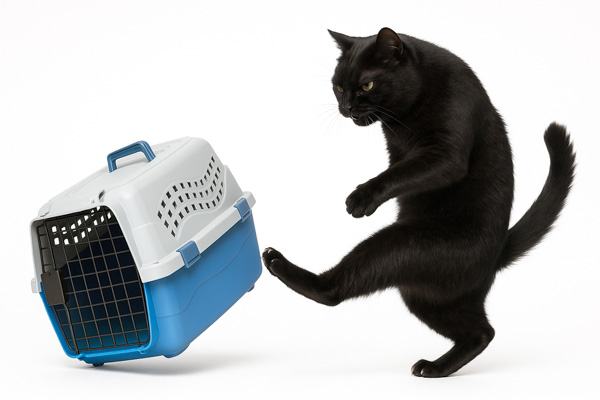
So your cat needs to go in their carrier for a trip of some sort. You pull the carrier out from a storage room, shuffle your cat into it against their will, and expect the trip to go just fine.
Except it doesn’t.
Your cat screams nonstop, fights to come out, or worse – pees or poops inside the carrier.
And they hate you for doing such a horrific thing to them in the first place. Now even your relationship is shaken.
Then you act surprised that all this happened. You ask, “What’s wrong with my cat? How dare they act like this?”
But in reality, your cat acted exactly as they should. you’re the one who did everything wrong.
So let’s take an honest look at the very common cat carrier mistakes cat parents make (on autopilot), so you can take accountability, and start making things right for your poor cat.
Mistake #1: Skipping Cat Carrier Training Altogether
This one is kinda hilarious, because so many cat parents don’t even bother doing any cat carrier training in the first place, yet somehow expect their cat to magically enjoy being trapped in a box.
No living creature will accept being shoved into a small, dark container without consent or context.
Carrier training isn’t optional. It’s a MUST.
Mistake #2: Using the Wrong Carrier
Cats hate small, dark, solid carriers.
Those hard plastic ones? They’re only useful for shelters and rescue organizations, where carriers have to be stacked or sanitized quickly. But you – the cat parent – should never use them.
Cats can’t spread their scent on solid plastic, so they’ll never take it as part of their territory. They also can’t see what’s happening around them, which makes them feel trapped and unsafe. Not to mention, most of them are ridiculously small in size.
What to do Instead:
Choose a large, soft, bright carrier with lots of openings and mesh panels. So your cat gets airflow, visibility, and comfort all together. Those are the only carriers suitable for cat carrier training, otherwise it will fail.
Mistake #3: Keeping the Carrier hidden away
When you hide the carrier away and only bring it out when it’s needed, your cat sees it as something foreign and scary.
They don’t get the chance to sniff it, own it, use it, or get comfortable in it.
Fix it:
Once you get the right type carrier, keep it wide open in your cat’s living area. Let your cat use it, nap in it, or play in it.
Make it part of their environment, not an alien object that appears once a year.
Mistake #4: Forcing Your Cat Inside the Carrier
Many cat parents believe that forcing their cat inside the carrier is the only way to get them there. But it’s actually the worst thing you can do. Not to mention, it’s disrespectful and a violation of your cat’s physical and emotional boundaries.
If your cat doesn’t want to go inside the carrier on their own, it means they don’t feel safe enough yet.
That’s exactly what carrier training is for, to help your cat builds positive associations with the carrier and willingly step inside on their own.
The goal is for your cat to see the carrier as a cozy, familiar bed where only good things happen: treats, play, affection, or even naps.
Mistake #5: Using the Carrier Only for Bad Trips
Most cat parents use the carrier only for vet visits or relocations – two of the most stressful experiences for any cat. So your cat now thinks of the carrier as a vehicle to hell. No wonder your cat avoids it at all costs.
Change the story:
Start using the carrier for good trips too. Take your cat to the backyard, patio, or a quiet garden nearby. Let them safely enjoy nature, sunshine, and new smells while inside the carrier.
When you do that, the carrier turns from a symbol of trauma into a doorway to new adventures.
Final Thoughts
Your cat is terrified, confused, and trying to protect themselves from the monster “carrier”.
The good news? You can change that. And now you know how
By choosing the right carrier, keeping it accessible to your cat, making it a part of their safe space, and using it for joyful moments, and fun trips.
That way, you’ll rebuild trust and rewrite your cat’s entire emotional story around it.
Do that, and next time, your cat will just walk inside the carrier on their own – with their tail held high.
If this explained exactly why your cat panics around the carrier…
Carrier hatred isn’t stubbornness. It’s learned fear, rushed handling, and poor setup. In my 1:1 online cat behavior breakthrough session, I help cat parents reframe the carrier from a threat into a safe, neutral space by changing how it’s introduced, used, and integrated into daily life, without force or flooding.
I’m a holistic cat trainer based in Vancouver, supporting conscious, loving cat parents locally and online across Canada and the US through my signature holistic cat training programs and cat introduction programs.
Regulation Starts in The Bowl

Get your FREE cat food ingredient decoder to learn how to read labels like a pro, and know which brands to buy and avoid.