
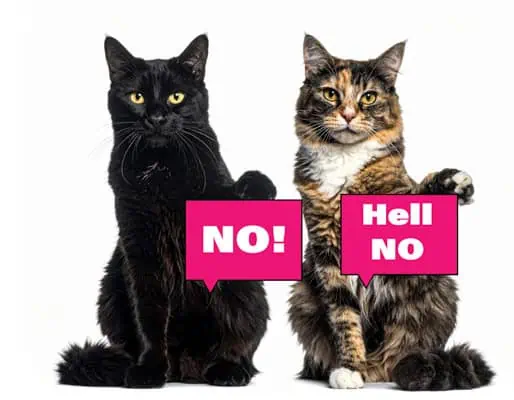
I’ve been doing cat introductions since I was very young, and over the years my own beloved cats have taught me more than any book or “expert” advice ever could.
Today, I do them professionally – and let me tell you, most cat parents come to me as a last resort. By the time they find me, they’ve already tried every bad piece of mainstream advice out there, and things have gone from bad to worse.
So, I want to save you time, energy, and heartache by exposing the biggest mistakes right from the start.
If your cat introduction is failing, this has nothing to do with your cats. It’s only because you’ve been following the wrong playbook.
Here are the worst advices I see online (and why they fail). Stop doing these, and you’ll finally be able to work with your cats instead of against them.
Mistake #1: Giving Your Cat Anti-Anxiety Medications
Think pills will make your cats like each other? Think again.
Drugs don’t build relationships.
At best, medication will make your cat drowsy and less alert. At worst, it will mess with their health and well-being.
Would you take anti-anxiety meds just to get along with someone you don’t like?! Exactly.
Mistake #2: Using a Feliway Diffuser
Any hormone diffuser, like Feliway, is a synthetic, generic scent. Real cats don’t smell like that, and each cat has a unique distinctive feline scent. Throwing artificial odor into the mix just adds confusion instead of comfort.
Mistake #3: Ignoring Your Cat’s Individual Needs & Struggles
Would you go on a blind date while broke, sick, or miserable? No. You’d fix your own life first. Yet people expect cats to “just get along” while they are having their own problems and daily struggles, like:
- Hating their litterbox.
- Being nutritionally starved.
- Feeling like guests in their own home.
- Rotting in boredom all day.
- Living trapped in a dark, airless apartment.
You can’t ask a cat to overlook their struggles just to make a new friend.
Mistake #4: Using only Toys or Blankets for Scent Swapping
Cats experience the world through their noses. So doing a proper scent blending is critical in cat introductions. A toy or blanket isn’t enough, you need dedicated cat-only furniture to properly mix up their feline scents. Otherwise, it will take you years to do a proper scent swapping.
Mistake #5: Forcing Your Cats Together with Food
Food does not equal friendship.
Forcing closeness by feeding your cats side-by-side when they’re not ready to be near each other or even share the room is a recipe for stress and resentment. It’s like forcing you to eat with a total stranger when you are hungry!
Cats take their physical boundaries and personal spaces very seriously.
Ignore that, and they’ll show you just how serious they are.
Mistake #6: Skipping the Full Separation Stage
“Let’s just toss them together and see what happens.”
Translation: Disaster.
To a cat, sharing the space with another cat is as intimate as sleeping in the same bed is to us.
You don’t rush intimacy, you build toward it slowly and safely.
Mistake #7: Labeling the Fighter Cat as “Aggressive”
There is no such thing as a “bad cat.” Territorial cats aren’t wrong for protecting their homes. And fearful cats aren’t wrong for running away either.
What’s wrong is expecting them to figure it out without your guidance.
Respect their personalities and work with them.
Mistake #8: Ignoring the Human Relationship Factor
Two partners move in together with their cats, but neither takes the time to bond with the other’s cat.
Guess what happens? Friction.
If they don’t trust or feel comfortable with their new human, they won’t trust their cat either.
Mistake #9: Believing There Are Only “Social” or “Anti-Social” Cats
This myth is ridiculous. Cats aren’t fixed into neat categories.
I’ve seen “anti-social” cats thrive with the right partner, and “super-social” cats fail miserably when paired poorly.
It all depends on each cat and how the introduction is done.
Mistake #10: Rushing the Introduction
The #1 mistake: Speed.
Cat parents try to go from first meeting to roommates overnight.
Imagine moving in with someone after a single blind date. Madness.
Then they wonder why they’re stuck reintroducing their cats over and over again.
Slow down. Your cats aren’t ready.
Mistake #11: Letting Your Cats ‘Fight It Out’
This one makes my blood boil. Would you let your kids or teenagers “fight it out” and hope for the best? Of course not.
Letting cats battle is a complete failure of responsibility.
Best case scenario: chronic stress that leads to sickness.
Worst case scenario: serious injury.
Either way, it’s a lose-lose
Final Thoughts
You need to work with your cats, not against them.
Cats introduction is a relationship building process, and it needs to be done at your cat’s terms, not yours.
If this made you realize how easy it is to get cat introductions wrong…
Cat-to-cat introductions fail when we rush, generalize, or ignore individual emotional needs. Successful introductions are a slow, intentional relationship-building process, not a checklist or a trick. In my 1:1 online cat behavior breakthrough session, we set the foundation for a proper cat-to-cat introduction, and create the roadmap for success.
I’m a holistic cat trainer based in Vancouver, supporting conscious, loving cat parents locally and online across Canada and the US through my signature holistic cat training programs and cat introduction programs.
Regulation Starts in The Bowl
Get your FREE cat food ingredient decoder to learn how to read labels like a pro, and know which brands to buy and avoid.