
It breaks my heart when I see even the most well-intended, loving dog parents labeling their dogs as “Reactive”, “Aggressive”, or even “Not friendly”.
Your assumption is entirely wrong.
Your dog isn’t broken, damaged, weird, or just “wired wrong.”
What’s broken is the lens you’re using to see them.
Because everything your dog does and doesn’t do makes PERFECT sense.
Your confusion is only because you don’t yet understand what you’re looking at.
And most dog parents don’t, because they’ve been taught to see their dogs through a distorted framework.
This post is not about fixing behavior, it’s about exposing your blind spots, so you can see the real problem your dog’s behavior is trying to solve.
Misconception #1: “Something Is Wrong With My Dog”
When your dog struggles, reacts, shuts down, explodes, freezes, or seems “difficult,” the immediate conclusion is that something is wrong with them.
But let’s slow this down.
Dogs NEVER act randomly just to make your life harder.
Every behavior is a response to context, pressure, confusion, fear, frustration, unmet needs, or lack of choice.
Your dog’s behavior is an output, not an input.
Your dog simply cannot be wrong. They just can’t.
What’s wrong is assuming that their behavior exists in a vacuum.
If your dog lived in your body, with your autonomy, your language, your ability to leave situations, advocate for yourself, and change your environment, how many of their “issues” would disappear overnight?
This question alone should stop you in your tracks.
Misconception #2: “I Meet All My Dog’s Needs”
No, you don’t. Not even close.
You just assume so without ever getting your dog’s feedback.
Many dog parents have no idea who their dog even is or what they need.
Yes,
- You feed your dog.
- You walk your dog.
- You love your dog.
So of course their needs are met… right?
Wrong.
Let’s do a fair comparison.
Answer these questions for yourself first. Then answer them again for your dog.
- What do you do when you’re hungry? What can your dog do when they’re hungry?
- What do you do when you feel overwhelmed? What can your dog do when they feel overwhelmed?
- If your environment feels uncomfortable, can you change it? Can your dog?
- If you don’t feel safe somewhere, can you leave? Can your dog?
- Can you decide when to go outside, where to go, and for how long? Can your dog?
- Can you say no to anything or anyone and walk away? Can your dog?
We allow ourselves autonomy by default.
We deny dogs autonomy by design.
Then we label the fallout as behavioral problems.
That’s not a dog issue.
That’s a systems issue.
And if that made you wonder:
Does my dog need autonomy?
The answer is YES. Hell yes, they do.
They need the freedom to choose sometimes, and for us to follow, for a change, instead of dictating their every breath.
Misconception #3: “My Dog Is Reactive and This Is Bad”
Let’s take a step back and look at reactivity.
Reactivity is a nervous system response wired to fight, flight, or freeze when there is danger or unmet survival needs.
And reactivity is not just a nervous system response for dogs. It’s for all of us.
We are all wired with the same nervous system (fight, flight, freeze).
We just forgot, because we live in a different world called “civilization,” where we have laws and we can call 911.
Our main survival needs are not only met by default, we live in excess and abundance.
Our dogs don’t have any of this luxury.
And when we ignore that reality, we move straight into the next blind spot.
Misconception #4: “Behavior Should Be Trained Out”
Unfortunately, this belief is deeply normalized.
I call it “the root of all evil” belief
- If a dog reacts, we train it out.
- If a dog struggles, we manage it.
- If a dog expresses discomfort, we redirect it.
The focus is always on stopping the behavior.
Rarely do we ask ourselves, “what this behavior is trying to solve.”
Behavior is not the problem.
Behavior is the attempt to solve one.
It’s your dog doing the only thing available to them with the tools they have.
Imagine being unable to speak, leave, negotiate, or change your circumstances, and then being punished or corrected for reacting.
At some point, pressure builds. And when pressure builds without release, something breaks.
Not the dog.
The illusion that control equals care.
And let me ask you this:
What happens when you “misbehave,” lash out, or do something wrong? which I’m sure you do because you are human like the rest of us.
You get away with it, almost always. You forgive yourself and move on. And if you’re conscious enough to seek help, you seek therapy, not someone to train your behavior out of you.
Misconception #5: “Dogs Don’t Need What Humans Need”
This one hides behind good intentions.
- Dogs don’t need much.
- Dogs are simple.
- Dogs are happy with nothing.
That belief is convenient. And deeply inaccurate.
Dogs may not need the same things humans need, but they need the same states:
- Safety.
- Freedom.
- Connection.
- Relief from pressure.
- And the ability to express discomfort.
We don’t question these needs in ourselves. But we pathologize them in our dogs.
When dogs ask for space, we call it avoidance.
When they protest, we call it reactivity.
When they shut down, we call it calm.
The lens is so upside down.
The truth is we don’t give our dogs their basic needs by default.
Misconception #6: “This Is Just How My Dog Is”
This belief usually shows up after everything else has failed.
“I’ve tried everything.”
“This is just their personality.”
“They’re always going to be like this.”
But what you’re often seeing isn’t personality.
It’s adaptation.
It’s a nervous system doing its best under chronic limitation.
Dogs adapt until they can’t. And when adaptation runs out, symptoms appear.
Not because your dog is broken. But because their conditions never changed.
The Moral Blind Spots Most Dog Parents Are Not Aware Of
We allow ourselves freedom, expression, choice, and grace.
We deny dogs those same things. Then we judge them for struggling.
The irony is brutal.
Your dog isn’t asking for perfection. They’re asking for basics. And still not getting them.
Let me answer the first question I asked you earlier to drive this point home.
What do you do when you are hungry?
I bet you have a fridge and pantry full of food you love. And if you don’t feel like any of it, you have Uber Eats on speed dial and a ton of food options nearby.
You have zero restrictions on what to eat, when to eat, how much to eat, or even whether to snack.
Now what can your dog do when they’re hungry?
Or sick and tired of the same junk kibble they’ve been on for years?
Everything they can do, you already label as bad behaviors:
- Stealing your food.
- Eating food off the ground.
- Eating non-edible stuff because they don’t know what else to do to fill the void and make their body stop screaming for nutrients it’s not getting.
And if they come to you asking for food, you call it “begging” and deny them anything beyond what they’re already getting.
The unfairness is wild.
A Different Way to Look at Your Dog
What if nothing is wrong with your dog?
What if their behavior makes perfect sense once you stop seeing it as a problem and start seeing it as information?
What if the work isn’t about doing more, but about seeing differently?
That shift alone changes everything.
Not overnight.
Not magically.
But honestly.
And sustainably.
You’re finally seeing your dog for who they are, and you’re ready to see their world through their eyes.
Final Thoughts
The irony is we allow ourselves everything and deny our dogs those exact same things, then wonder why our dogs are going crazy.
Our dogs need freedom, choice, connection, relationships, and delicious nutritional food, for God’s sake.
They need to feel seen, heard, and supported.
They need to be allowed to express their fears, needs, and desires without judgment.
They need us next to them. Not judging them.
If this challenged how you’ve been interpreting your dog’s behavior…
It’s time to examine your blind spots. In my 1:1 online dog behavior breakthrough session, I help dog parents uncover these hidden lenses, understand what their dog is actually responding to, and shift the relationship in ways that naturally change behavior without force or shame.
I’m a holistic dog trainer based in Vancouver, supporting conscious, loving dog parents locally and online across Canada and the US through my signature holistic dog training programs.
P.S. If you live in Vancouver, BC, or can bring your dog here, and you’d prefer to work with me in person, check out my 1:1 Vancouver dog behavior breakthrough session.
Regulation Starts in The Bowl
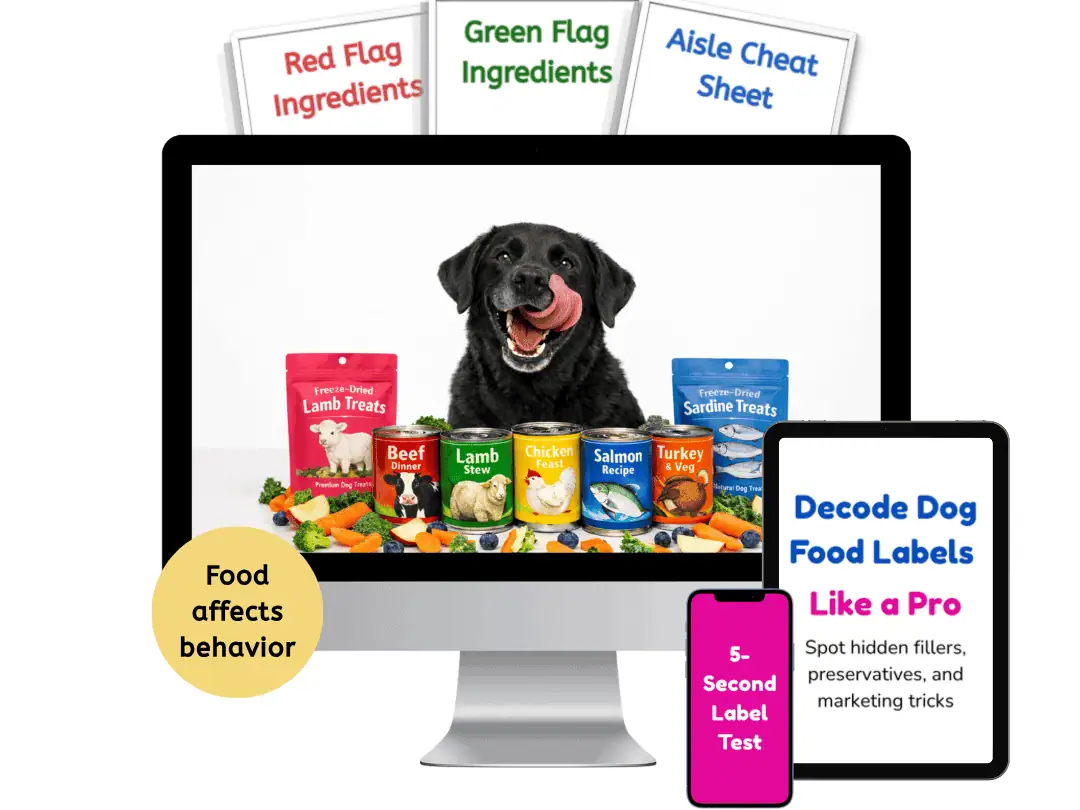
Get your FREE dog food ingredient decoder to learn how to read labels like a pro, and know which brands to buy and avoid.
Related Posts:
- Your Dog Pulls on the Leash Because They are Deprived – The Unmet Needs Dilemma
- The #1 Thing Missing From Dog Training? Your Dog’s Happiness
- The Scarcity Dilemma: Why So Many Dogs Are Starving in a World of Abundance
- The 5 Pillars of Holistic Dog Training: The Framework Behind Lasting Results
- 45 Dog Parenting Mindsets That Change Everything