This blog post is about what the dog training industry refers to as “fear aggression”.
Fearful dogs where their fear triggers a nervous system “fight” response.
I hate the term “fear aggression” because it’s judgmental, egotistic, and extremely misleading.
What set me off the other day
Let me tell you what set me off the other day first. This is sometime I see quite often, unfortunately!
I watched a dog bark his lungs out because he saw something that terrified him.
Tense body, eyes wide, breathing fast. Textbook fear.
His nervous system was yelling danger, danger, danger. I even felt it.
And instead of comfort, understanding, or even a moment of curiosity as to what triggered him, he got hit with a sharp “NO” from a trainer who thinks volume equals leadership, accompanied with a harsh pull on his leash.
Imagine a toddler screaming and his parent screaming back at him, then slapping him in the face.
Welcome to the reality of far too many dogs, who are not allowed to be scared.
Let’s break this down without sugarcoating it.
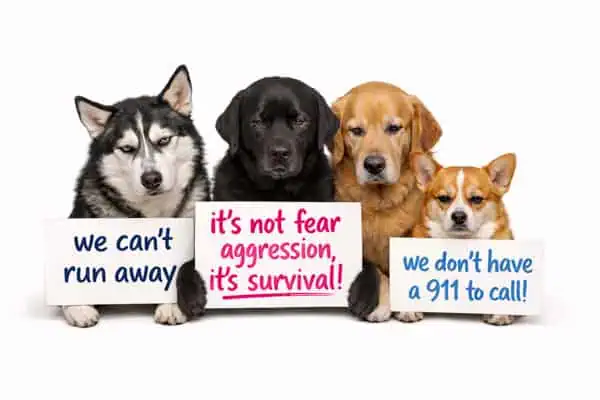
Fearful Dogs Are Not Fighting. They Are Surviving
A dog in fear does what any mammal does when their system flips into survival fight mode:
- They bark.
- They lunge.
- They pull.
- They air snap.
- They make themselves big, and louder.
- They even fight.
They’re trying to survive in a perceived life or death situation the only way they know how.
They are trying to get their safety back.
But the dog training industry loves labeling fear as “bad behavior”, especially when it triggers a fight response, because it’s easier to judge than to understand. So they call it “fear aggression” instead of calling it what it really is:
A survival system in a fight mode.
And obedience trainers who can’t even read body language? Even worse.
They punish the symptoms because they can’t comprehend the cause. An ego-driven reaction in a game they must win!
Fight Is a Nervous System Response, Not a Choice
Here’s the science that apparently the dog training industry chooses to ignore.
When a dog is scared, their sympathetic nervous system lights up like a Christmas tree.
Fight, flight, freeze.
That’s it. That’s the menu we all have, not just our dogs.
So stop acting superior as if you are wired differently. You are not.
None of us is above survival.
And let’s not forget that running away, “flight”, is not even an option in many situations, because your dog is leashed up.
Fight is a nervous system response, a very natural way for the body to defend itself.
A dog who is in a “fight” mood is literally operating from the survival part of his brain.
- The thinking brain? Offline.
- The emotional brain? Overwhelmed.
- The survival brain? Driving the show at full speed.
So it doesn’t matter which mode the nervous system is in, fight, flight, or freeze. It’s all survival, and it’s all fear.
Punishing fear is like yelling at someone for having a panic attack.
Yet here we are, watching people do it daily and calling it “training.”
The Industry’s Favorite Lie: Control First, Understand Never
How we betray our dogs every single day.
What I saw is nothing new. It’s celebrated, normalized, even marketed as “results.”
- Dog barks in fear? Trainer barks louder.
- Dog pulls or snaps in fear? Trainer aggressively pulls them like they are a robot, not a living being.
- Dog is overwhelmed? Trainer overwhelms them more.
- Dog needs space? Trainer crowds them.
Then everyone claps because the dog stopped barking or stopped pulling. The humans won.
And the poor dog is suppressed and in total shutdown mode. Because the humans who are supposed to protect this poor dog are even worse than what triggered this dog in the first place.
Fear silenced is not fear resolved.
And a suppressed nervous system always comes back with interest.
Why Suppression and Control Make Everything Worse
“NO” or an aggressive pull back on a leash can’t make a survival system stop on command.
What a scared dog, who is probably restricted while trying to survive, hears:
- You’re alone.
- Your fear is wrong.
- You need to ignore everything your body is telling you to do, and obey me.
- I won’t help you.
- Figure it out yourself. But survive in silence.
The dog’s heart rate spikes even more.
His stress hormones double down.
His survival mode intensifies.
And now he’s not just scared of the trigger, he’s scared of YOU.
Congratulations, the relationship is collateral damage.
The long-term impact of this repeated scenario is:
- Generalized anxiety
- Learned helplessness
- Chronic hypervigilance
- Trust erosion beyond walks
If this scenario doesn’t identify what dog emotional abuse is, I don’t know what does!
What a Fearful Dog Actually Needs
Let’s talk solutions, because correcting fear with fear gets us nowhere.
A scared dog needs emotional safety.
That’s the only thing that calms down a nervous system. And a calm nervous system doesn’t need to fight.
A scared dog needs a conscious parent who notices early signs.
- Support, not suppression.
- Gentle guidance, not intimidation.
- Space to decompress so the brain can come back online.
Then gradual and gentle exposure to scary triggers, so fear turns into confidence.
When your dog trusts that you always help them feel safe, their fear response drops naturally.
Because the root problem is addressed instead of slapped down.
What I Wish Every Dog Parent Knew
I don’t know your dog. But I know they deserve way better than being shamed for being afraid.
If your dog barks, lunges, growls, or even snaps when scared, they’re not trying to embarrass you.
They’re asking for your help using the only language they have.
Fear is distress.
And if we treat distress like defiance, we become the problem.
Forget about how the fear is being expressed, and focus on understanding and recognizing your dog’s fear response first.
Once you do, create safety fast. That’s your go-to move.
Final Thoughts
When your dog is scared, they need you to step up and be the parent you are meant to be.
They need you to understand them, support them, and make them feel safe again in that moment.
Dog fear aggression is a nothing but a survival system in fight mode, which we all have.
I hope this helps you see your dog, not the label.
If this made you question how fear-based behaviors are usually handled…
A scared dog doesn’t need correction. They need safety, predictability, and a nervous system that can finally stand down. In my 1:1 online dog behavior breakthrough session, where we stop fighting symptoms, and start rebuilding emotional safety, confidence, trust, and nervous system regulation, so real behavioral change can happen without further harm.
I’m a holistic dog trainer based in Vancouver, supporting conscious, loving dog parents locally and online across Canada and the US through my signature holistic dog training programs.
P.S. If you live in Vancouver, BC, or can bring your dog here, and you’d prefer to work with me in person, check out my 1:1 Vancouver dog behavior breakthrough session.
Regulation Starts in The Bowl

Get your FREE dog food ingredient decoder to learn how to read labels like a pro, and know which brands to buy and avoid.
Related Posts:
- Commands Are Cheap. Trust Is Priceless. Does Your Dog Trust You?
- The Conscious Dog Parent Mindset: The Beliefs That Transform Behavior
- Are You Your Dog’s Safe Container?
- The Real Reason Vancouver Dogs Are Becoming Reactive, and The Way Out
- 16 Aggressive Dog Behaviors. And Why Your Dog Needs To Do Them
- Your Dog Isn’t Broken. Your Lens Is