
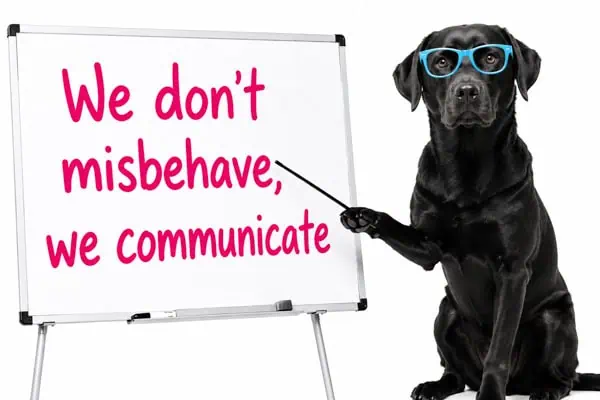
Most dog parents are way too busy judging, controlling, and suppressing their dog’s behavior instead of making the slightest effort to actually understand it.
They treat behavior like a choice their dog makes to disobey or get away with something, completely ignoring the internal emotional drivers behind it. They miss the “why,” which naturally leads to even more intense behaviors.
All dog behaviors we label as “unwanted” – barking, lunging, whining, chewing, pulling, or biting – have a meaning behind them.
And your dog has abolutely no choice but to act this way.
This post is your dog’s voice. Why they behave the way they do, and how you can truly help them – from their point of view.
Understanding dog communication requires looking past labeling, controlling, and suppressing behaviors.
Your Dog Never Misbehaves or Acts Out
Dogs communicate through behavior because behavior is how their internal world becomes visible.
Nothing your dog does is “for no reason.”
Behavior is always communication. It’s never malicious and never carries any bad intention.
The real issue is not that dogs are unclear.
The real issue is that humans are trained to value compliance over honesty.
We ask dogs to be calm, polite, friendly, tolerant, quiet, social, patient, and convenient, then act shocked when their nervous system starts leaking out through behavior.
Behavior is not the enemy.
Behavior is the evidence.
If your dog “disobeys” you, it’s because they have to.
Dogs communicate through behavior by expressing their internal physiological state and unmet needs.
It’s their way of telling us what they feel or need in any given moment and asking for our help.
Dog behaviors are attempts to communicate discomfort, fear, stress, or unmet needs.
Dogs can’t behave or misbehave by choice.
Why Dogs Use Behavior More Than Body Language to Communicate
Dogs have very limited communication channels. Those channels are mainly body language and behavior.
They don’t have language.
They can’t meet their own needs or solve their own problems.
All they can do is communicate to us.
There’s a strong obsession with learning dog body language while, at the same time, dismissing or suppressing behavior, which is ironic.
The reality is, body language is a complementary communication channel to behavior – not the other way around.
Think of body language as muted communication signals, a more subtle form of physical expression.
When communication becomes urgent, behavior leads.
Behavior is the louder signal. The clear message that something needs attention.
How to Become Your Dog’s Behavior Detective
That’s your job as a parent because you have all the power. You are the only one who can meet your dog’s needs and solve your dog’s problems.
In order to decode your dog’s behavior, find and address the root cause, and actually help your dog, you need to:
Drop the resistance
Understand that behavior is not a choice your dog makes to dominate or disobey. It’s them doing their best to handle a challenge. There’s nothing to resist.
Stop reacting to the behavior
Most mainstream advice tells you to ignore, suppress, or correct behavior. That doesn’t address what’s driving it, it just makes it worse. And creates more frictions between you and your dog.
Get very curious
Investigate what need or concern is being communicated.
Is it a lack of emotional safety? A nervous system response (fight, flight, freeze)? An unmet need? A conflict of interest?
Once you can read your dog’s internal world, everything becomes so easy.
Respond properly
Once you identify what’s driving the behavior, meet the need or remove the pressure. That’s what a healthy relationship looks like.
The Shift: What Happens When You Start Listening
When we get triggered by our dog’s behaviors, when we judge, complain, resist or even suppress them, all we are doing is blocking any chance to understand their needs, wants and struggles. This place will get you nowhere.
The shift happens when you drop all that and just get curious, because when you do, this is when everything changes.
Your dog will start to trust you and see you as a source of safety and support instead of pressure.
Because, for the first time, you stop being reactive and controlling, and you start acting like a loving, caring parent.
As you learn to read your dog like an open book, properly respond to their needs and wants, their behaviors will start to fade away.
Once you listen to your dog’s whisper, they no longer need to scream.
Your relationship and bond will grow stronger every day.
Final Thoughts
Dogs communicate through behavior because behavior is how their internal world becomes visible.
Reading body language alone will never give you the full story, behavior will.
So the goal is never to resist or suppress the behavior.
The goal is to understand the message behind it and respond to it.
Your dog is always doing their best.
It’s time that you do too.
If your dog is struggling, and you just can’t understand their “why,” it usually means something important is being missed. That’s exactly what I uncover in my 1:1 online dog behavior breakthrough session– where we break down what’s actually going on and give you a clear way forward to understand and connect with your dog like never before.
I’m a holistic dog trainer based in Vancouver, supporting conscious, loving dog parents locally and online across Canada and the US through my signature holistic dog training programs.
P.S. If you live in Vancouver, BC, or can bring your dog here, and you’d prefer to work with me in person, check out my 1:1 Vancouver dog behavior breakthrough session.
Regulation Starts in The Bowl

Get your FREE dog food ingredient decoder to learn how to read labels like a pro, and know which brands to buy and avoid.
Related Posts:
- Your Dog Pulls on the Leash Because They are Deprived – The Unmet Needs Dilemma
- 16 Aggressive Dog Behaviors. And Why Your Dog Needs To Do Them
- The Scarcity Dilemma: Why So Many Dogs Are Starving in a World of Abundance
- The 5 Pillars of Holistic Dog Training: The Framework Behind Lasting Results
- 45 Dog Parenting Mindsets That Change Everything