
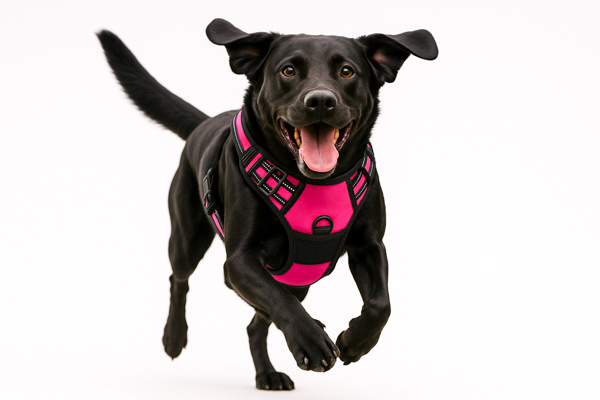
The harness is the only thing that should go on your dog’s body. Period.
When it comes to walking your dog, the only piece of equipment that respects their body, protects their nervous system, and keeps your bond intact while keeping them safe outside is a harness.
Not just any harness. A comfortable, well-fitted, lightweight harness that lets your dog move like a dog, breathe like a dog, and exist with dignity. Not the restrictive, stiff, “no-pull” torture devices built to control, contain, or correct.
If you love your dog, a harness isn’t optional. It’s the only real choice.
On a side note: I’m a holistic dog trainer, and I only walk my dog clients on comfortable harnesses regardless of their size or reactivity level on walks.
Here are the benefits of dog harnesses that many dog parents aren’t even aware of.
Benefit #1: Harnesses Are Safe for Your Dog’s Body
Collars put pressure where your dog is most vulnerable: the neck. The neck holds the trachea, major blood vessels, nerves, lymph nodes, thyroid gland… basically everything you shouldn’t mess with.
Even mild leash pressure can lead to coughing, throat irritation, and long-term structural damage.
A harness bypasses all of that. It distributes movement across the chest and shoulders, the parts of the body built to bear weight and handle impact. No choking, no compression, no cumulative harm every time your dog moves an inch.
When the body feels safe, the nervous system feels safe too.
A regulated nervous system is the foundation of good behavior.
Benefit #2: Harnesses Are Comfortable to Wear
A proper harness feels natural to your dog. It’s not squeezing, scraping, digging, or rubbing. It doesn’t remind your dog every second that something is strapped to them.
A comfortable harness lets your dog:
- walk longer
- explore freely
- focus on the world, not the gear
- move without compensating or bracing
That comfort is what lets your dog stay in “learning mode” instead of “survival mode.”
Comfort equals safety.
Safety equals regulation.
Regulation equals responsiveness.
Benefit #3: Harnesses Give Your Dog Freedom of Movement
Movement is emotional medicine for dogs. Restrict movement and you restrict confidence.
A well-fitted harness lets your dog:
- trot naturally
- run
- climb
- sniff
- dig
- navigate uneven ground
All without fear of being yanked by the throat.
And that freedom does something powerful:
It builds confidence.
A free dog is a confident dog.
A confident dog is a regulated dog.
A regulated dog is a stable, social, grounded dog.
Restriction leads to stress.
Stress leads to reactivity.
Reactivity is not a “behavior issue”, it’s a nervous system issue shaped by how safe or unsafe the body feels on a walk.
The right harness shifts your dog out of threat and into curiosity. And that shift changes everything.
Benefit #4: Harnesses Support Nervous System Regulation
Your dog’s nervous system responds instantly to physical sensations.
Pressure on the neck tells the body:
Danger. Brace. Prepare to fight or flee.
Pressure on the chest tells the body:
You’re supported. You can breathe. You’re safe.
This one physical detail determines whether your dog walks through the world:
- scanning for threats
- barking at movement
- reacting to every dog
- pulling out of stress
- trying to escape discomfort
Or…
Exploring with confidence, softness, and emotional balance.
When the body feels safe, the brain can relax. And when the nervous system is regulated, your dog can actually learn.
Switching to a harness often reduces reactivity before you’ve even trained anything.
Benefit #5: Harnesses Respect Your Dog’s Body
You can’t train a dog without respecting their body.
Respect comes before training. Every single time.
Your dog’s body wasn’t designed for neck pressure or throat tension. It was designed for flow. Movement. Breath. Agency.
A harness honors that design. It says:
“I see you. I value your comfort. I won’t risk your health for my convenience.”
This alone transforms walks from control-based to connection-based.
If you wouldn’t put a collar around your child’s neck and drag them around, don’t do it to your dog.
And yes, kids wear harnesses too. Because it keeps their bodies safe.
Benefit #6: Harnesses Build Trust
Every time your dog feels neck pressure, they learn one thing:
You are the source of their discomfort.
And discomfort erodes trust.
Fear and pain don’t build connection. They build survival mode. They teach your dog that you are unpredictable and potentially unsafe.
A harness communicates the opposite:
“You’re safe with me. I protect your body, not harm it.”
That one shift turns walks into trust-building rituals instead of power struggles.
Benefit #7: Harnesses Make Managing Pulling Much Easier
Does a harness magically stop pulling?
No. And nothing should magically stop anything because behavior isn’t magic – it’s communication.
But a harness does give you:
- more effortless control
- better leverage
- easier redirection
- calmer handling
- a safer way to guide your dog without hurting them
The reason?
A harness covers more surface area. It gives you gentle influence without pain.
And when your dog isn’t choking or bracing against discomfort, they’re far more receptive to learning loose-leash skills.
A regulated body learns faster than a stressed body. Always.
Benefit #8: Harnesses Create a Better Relationship
Walks are not “just walks.” They’re your daily relationship practice.
Every time you clip into your dog, you are communicating something about your partnership:
- Is it mutual?
- Is it respectful?
- Is it safe?
- Is it built on trust or control?
A harness communicates respect, safety, and emotional stability.
A collar communicates the opposite.
Dogs thrive when they feel:
- secure
- understood
- comfortable
- free
A harness is the simplest way to give them all four.
Ready to Make the Switch?
Your dog has only one body and one nervous system. Don’t gamble with either.
Choose a harness that:
- fits comfortably
- supports natural movement
- protects their neck
- regulates their nervous system
- and honors their dignity
When you protect their body, you protect their confidence.
When you protect their confidence, you protect your relationship.
If this changed how you think about what your dog wears on walks…
Harnesses aren’t just a walking tool. They directly affect your dog’s body, movement, nervous system, and sense of safety. In my 1:1 online dog behavior breakthrough session, I help dog parents choose the right harness, adjust fit properly, and rebuild walk dynamics in a way that supports comfort, trust, and regulation instead of tension and control.
I’m a holistic dog trainer based in Vancouver, supporting conscious, loving dog parents locally and online across Canada and the US through my signature holistic dog training programs.
P.S. If you live in Vancouver, BC, or can bring your dog here, and you’d prefer to work with me in person, check out my 1:1 Vancouver dog behavior breakthrough session.
Regulation Starts in The Bowl

Get your FREE dog food ingredient decoder to learn how to read labels like a pro, and know which brands to buy and avoid.
Related Posts:
- The Hidden Dangers of Dog Collars: What Every Dog Parent Needs to Know
- Your Dog Pulls on the Leash Because They are Deprived – The Unmet Needs Dilemma
- Why Your Dog Is Calm at Home but Reactive Outside
- The Psychology of a Confident Dog: What Reactive Dogs Are Missing
- The 5 Pillars of Holistic Dog Training: The Framework Behind Lasting Results